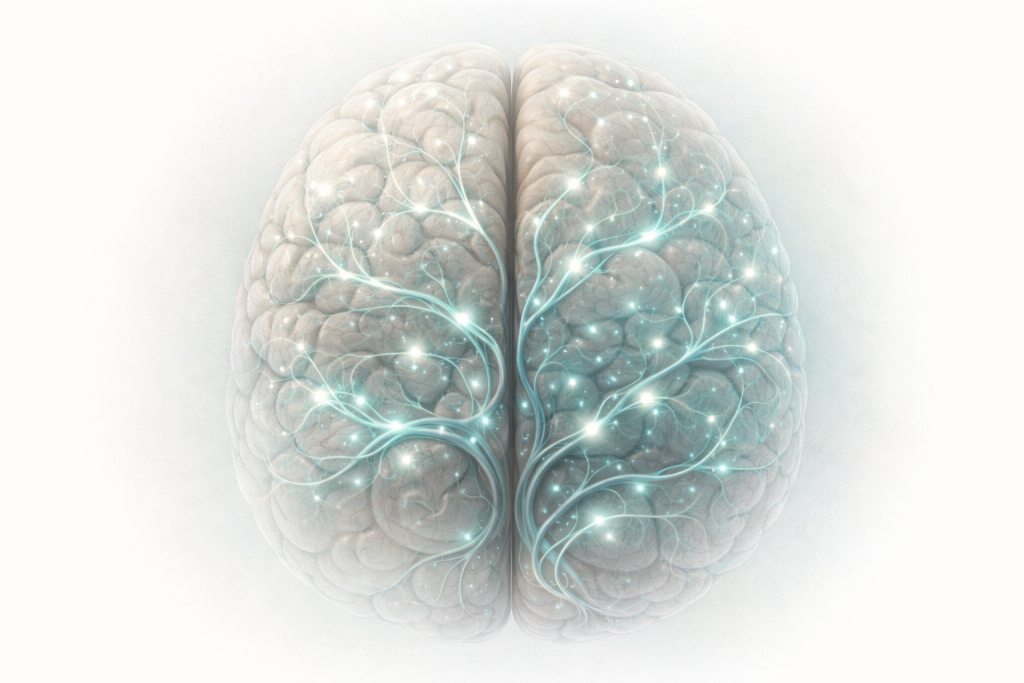
Vascular Dementia
Cognition Under Circulatory Constraint
Overview
Vascular Dementia (VaD) is a neurocognitive disorder resulting from impaired cerebral blood flow and cumulative vascular injury to the brain. Unlike neurodegenerative dementias driven primarily by misfolded proteins, VaD arises from disruption of the brain’s circulatory infrastructure—the systems responsible for delivering oxygen, glucose, and metabolic support to neurons.
VaD exists along a spectrum. It may follow overt events such as ischemic or hemorrhagic stroke, or emerge insidiously from chronic microvascular disease, repeated silent infarcts, or long-standing hypoperfusion. In clinical reality, vascular pathology frequently coexists with Alzheimer’s disease, producing mixed dementia.
Even modest and repeated vascular inefficiency can degrade attention, executive function, processing speed, and working memory long before major neurological events are detected.
Foundational Biology of Vascular Dementia
Normal cognitive function depends on neurovascular coupling—the precise coordination between neuronal activity and local blood flow. When neurons activate, surrounding blood vessels dilate to deliver oxygen and glucose. In vascular dementia, this coupling progressively fails.
Damage to cerebral arteries, arterioles, capillaries, and venules compromises perfusion, leading to metabolic stress, synaptic dysfunction, and eventual neuronal loss. The brain’s white matter, with its long axonal tracts and limited collateral blood supply, is particularly vulnerable.
Over time, cumulative vascular insults fragment neural networks rather than destroying isolated regions, producing the characteristic stepwise or fluctuating cognitive decline seen in VaD.
Medical Word Breakdown
- Neurovascular Coupling: Coordination between neuronal activity and blood flow.
- Hypoperfusion: Chronically reduced blood flow insufficient for tissue needs.
- White Matter: Myelinated axonal tracts connecting distant brain regions.
Core Pathophysiological Mechanisms
Microvascular Injury
Small vessel disease is the dominant driver of vascular dementia. Chronic hypertension, diabetes, and aging damage arterioles and capillaries, causing vessel stiffening, luminal narrowing, and impaired autoregulation.
White Matter Degeneration
Reduced perfusion leads to demyelination, axonal injury, and loss of network efficiency. Clinically, this manifests as slowed thinking, impaired planning, and reduced attention.
Blood–Brain Barrier Breakdown
Vascular injury disrupts blood–brain barrier integrity, allowing inflammatory mediators to infiltrate neural tissue and accelerate cognitive decline.
Medical Word Breakdown
- Small Vessel Disease: Chronic pathology of cerebral microvasculature.
- Blood–Brain Barrier: Protective interface separating blood from brain tissue.
- White Matter Hyperintensities: MRI markers of ischemic white matter injury.
Systemic and Overlooked Contributors
Chronic subclinical ischemia, endothelial dysfunction, and impaired clearance of neurotoxic proteins all contribute to VaD progression. Vascular pathology also worsens amyloid and tau accumulation, explaining the prevalence of mixed dementia.
Clinical Presentation
- Executive dysfunction and slowed processing
- Gait instability and balance impairment
- Emotional lability or apathy
- Stepwise or fluctuating cognitive decline
Diagnosis and Evaluation
Diagnosis integrates clinical findings with neuroimaging and vascular risk assessment. MRI typically reveals white matter hyperintensities, lacunar infarcts, or vascular-pattern atrophy.
Management and Intervention Strategies
Vascular dementia progression is highly modifiable. Interventions include strict blood pressure control, metabolic management, physical activity, smoking cessation, and targeted vascular therapies.
Closing Perspective
Vascular dementia reframes cognition as a circulatory achievement. When blood flow falters, cognition fragments. Early recognition and vascular optimization can meaningfully alter disease trajectory.
Selected References
- Iadecola, 2013 — Vascular Contributions to Cognitive Impairment and Dementia
- Gorelick et al., 2011 — Vascular Dementia: Pathophysiology and Diagnosis
- Sweeney et al., 2018 — Blood–Brain Barrier Dysfunction in Neurodegenerative Disease